The Millennial Kingdom
Science, sport, literature and art are also part of this search. Here is its personal history, for those who would like to read further.
I started university in 2017, passionate about science—an adjective I found myself guilty of—studying course books such as Atkins, Levine, Tipler–Mosca, Griffiths and Purves from the very beginning, or listening on YouTube to lectures by Lewin, Sagan and Sapolsky. While studying the banana bond in diborane for Inorganic Chemistry, I watched channels such as Veritasium and Kurzgesagt, which stimulated a more applied side of science. I must admit that I would also fall asleep listening to the calm of Alan Watts. Much later, I began to understand that bringing those two “worlds”—the technological and the real—together was not merely a generational calling, but humanity’s historical calling. Grandiloquent as that may sound, it is objectively true.
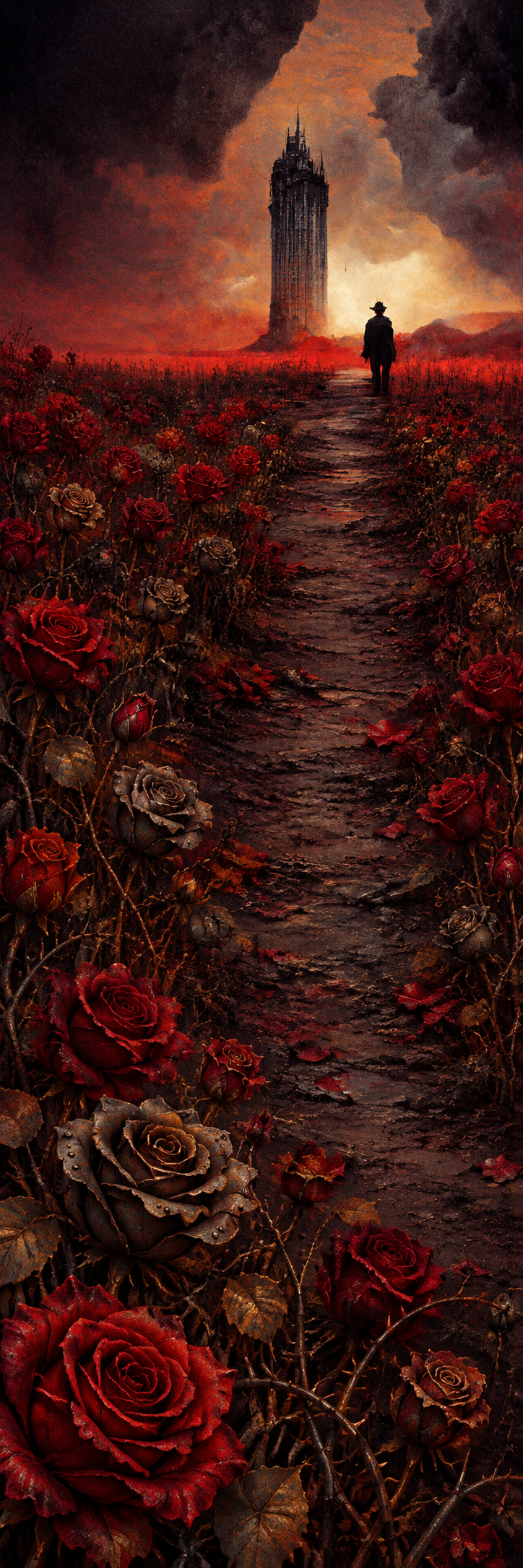
The novel that accompanied my childhood and early adolescence, S. King’s The Dark Tower, is paradoxically set in an interdimensional post-apocalyptic world where technology and the “thinking machines” form the graveyard upon which the characters’ journey is built. One of the lines that has stayed with me most comes when Jake says to Roland, before falling into an abyss: “There are other worlds than these.”
What I mean is that no one was untouched by the technologisation of our surroundings. Nor, at the time, did I make the mistake of thinking that what we call art—or spirit—would have nothing to contribute; I immersed myself in the works of Borges, Cortázar, Rimbaud, Whitman, Rilke, Bolaño, Sábato, Pizarnik, Paz, Jodorowsky and T.S Elliot. That search for the millennial kingdom had consequences. It is difficult to explain. Perhaps someone who has read Rayuela will understand me better. Eventually, poetry led me to the stage (I wanted to move from text to action) and to the football pitch: my sacred places, where no AI can interfere. Family, friends, diving, cinema and entertainment are sacred too... As I said, I serve the sentence of the passionate.
Certain of this true north that nourishes these very words—human-made—and of belonging to a generation whose divine charge was the alliance of the real, the tangible and what is valuable in nostalgia with a technology that seems to carry, in the costs of its reductionism, an uncertain future. I used AI towards the end of my degree, and I used it with judgement. I studied the sources myself and then debated them with it. I tested it. I explained what I intended. I taught it. I reached serious discussions such as: but how does the electron “move”—it does not move; it vibrates over the oscillating magnetic field—in a cable within a solar-panel circuit? How is that interpreted in terms of molecular orbitals? What, then, is electricity? How does it affect...? You get the idea. I never debated questions connected to God or to what belongs to art and human experience. Whenever I tried to discuss poetry, I always found in it what Zelnick, CEO of the company that owns Rockstar Games, said in one way or another: “Creativity, by definition, cannot exist in any AI model because it is data-driven. So datasets by their very nature are backward-looking. Creativity by its very nature is forward-looking.” That is why I always kept it in the scientific realm, where I believe its capabilities are best expressed. That does not mean I was uninterested in its opinion on a range of other matters. We could say that I understood that learning to use it was also a skill.
My position begins with a commitment to what is human: incorporating AI to expand our capabilities and our autonomy. To let us go further without becoming strangers to our own decisions.
To say that intelligence has become a commodity is to mistake a part for the whole. Producing answers is becoming cheaper; understanding what they mean, judging their consequences and deciding what is worth doing remain responsibilities we must take on. We can automate tasks, even some we used to call intellectual. Responsibility for their purposes remains ours.
The warning against handing our thinking over to machines still holds: we can gain the power to act while losing the ability to direct our actions. That is why justifying the use of AI requires us to ask what we learn with it, what we stop practising and how much room we retain to question it.
I aspire to a technology that gives us time, knowledge and freedom to build a life of our own. One that expands what is possible and finds us capable of choosing.
PS: In other words, to understand the future as something we must enter, bringing with us what we have already gained. Accelerationism will turn this letter into a vestige. I trust that I will learn more of what I still do not know. Until then, it will stand thus, the living fossil of a transition.
Finally, I want to recall a poem by Rimbaud, shared here in Spanish:
¡Ya el otoño! — Pero ¿por qué lamentar un sol eterno, si estamos comprometidos en el descubrimiento de la claridad divina, lejos de aquellos que mueren al ritmo de las estaciones?
El otoño. Nuestra barca, elevada entre las brumas inmóviles, gira hacia el puerto de la miseria, la ciudad enorme bajo un cielo manchado de fuego y de barro. ¡Ah, los harapos podridos, el pan empapado de lluvia, la embriaguez, los mil amores que me han crucificado! ¿No terminará entonces esta vampiresa, reina de millones de almas y de cuerpos muertos que serán juzgados? Vuelvo a verme con la piel roída por el barro y la peste, gusanos llenándome los cabellos y las axilas, y gusanos aún mayores en el corazón, tendido entre desconocidos sin edad, sin sentimiento… Podría haber muerto allí… ¡La espantosa evocación!
Pues puedo decir que la victoria me pertenece: los rechinares de dientes, los silbidos del fuego, los suspiros pestilentes se apaciguan. Todos los recuerdos inmundos se borran. Mis últimos remordimientos huyen: las envidias hacia los mendigos, los bandidos, los amigos de la muerte, los rezagados de toda especie. — ¡Condenados, si me vengara!
Hay que ser absolutamente moderno.
Nada de cánticos: mantener el paso conquistado. ¡Dura noche! La sangre seca humea sobre mi rostro, y no tengo nada detrás de mí salvo ese horrible arbusto… El combate espiritual es tan brutal como la batalla entre hombres; pero la visión de la justicia es placer reservado únicamente a Dios.
Sin embargo, estamos en la víspera. Recibamos todos los influjos de vigor y de ternura verdadera. Y al alba, armados de una ardiente paciencia, entraremos en las ciudades espléndidas.
¡Cómo podía hablar de una mano amiga! Una hermosa ventaja es que ahora puedo reírme de los viejos amores mentirosos y cubrir de vergüenza a esas parejas embusteras —he visto allá el infierno de las mujeres—; y me será permitido poseer la verdad en un alma y un cuerpo.
“The optimistic hope of finding a passable bridge between limits and infinity still breathes within me.”
— Alejandra Pizarnik, Diaries (1955 entry)
Comments or corrections? Get in touch.